Objective
The goal of this project was to create a sensor suite to monitor eutrophication by tracking runoff from the manure pile into the creek. The system relied on measuring secondary effects such as soil temperature and moisture to detect decomposing organic matter and water flow.
Design & Methodology
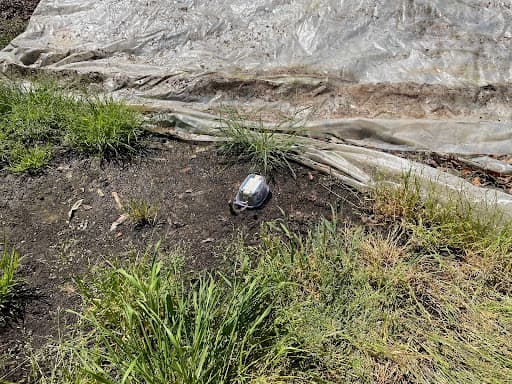
Three sensor suites were deployed at different locations: one near the manure pile, one near the creek, and a control sensor positioned away from both. These sensors used a thermistor to measure soil temperature, a soil moisture sensor to detect water flow, and a light sensor to estimate theoretical temperature calculations.
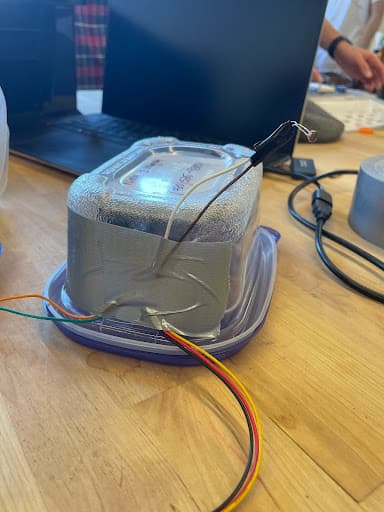
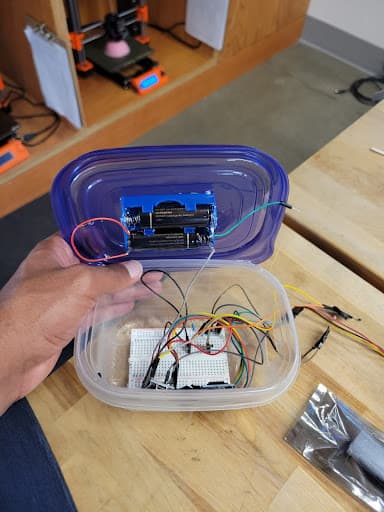
To protect the components from environmental conditions, we enclosed the sensors in a weatherproofed Tupperware container. Ventilation holes were drilled into the container to prevent condensation buildup, which was a problem encountered in initial designs.
Challenges & Iterations
Our first prototype suffered from condensation buildup due to an airtight container design. To address this issue, small ventilation holes were added, allowing moisture to escape. Additionally, a low-power mode intended to conserve energy caused malfunctions in the soil moisture sensor, leading to recurring errors. To resolve this, we removed the low-power mode.
Another challenge arose during deployment on the farm, where one of the sensors failed unexpectedly. This limited the amount of usable data collected, highlighting the need for more reliable hardware in future iterations.
Deployment & Findings
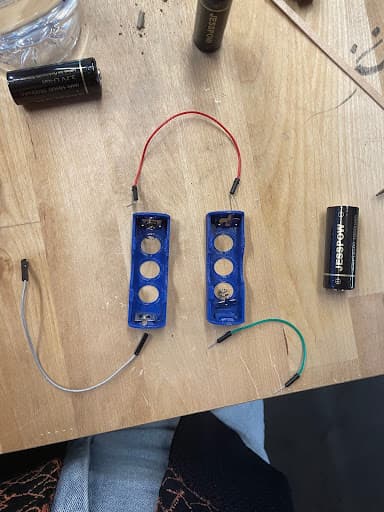
The sensors were deployed for two days, collecting data on light exposure and soil moisture levels. The light sensor readings correlated well with the time of day, though calibration issues caused inaccuracies. The soil moisture sensor functioned as expected, recording the highest moisture levels in the early morning hours. However, the temperature sensor failed, preventing us from obtaining a complete dataset.
Final Design Evaluation
The final design had several advantages. It successfully protected the sensors from environmental conditions while allowing air circulation, preventing condensation buildup. The collected data was organized and relatively easy to interpret. Additionally, the modular nature of the design allowed for easy replacement or adjustment of individual components.
However, there were also notable disadvantages. The enclosure retained heat, potentially affecting sensor accuracy. The plastic container, while inexpensive and accessible, is susceptible to degradation over time. Additionally, the failure of the temperature sensor limited our ability to fully analyze environmental conditions.
Future Improvements
To improve future iterations, we aim to explore more environmentally friendly sensor enclosures that are both durable and non-invasive. Expanding the deployment locations to cover more varied environments could provide a broader data set and improve accuracy. Additionally, assigning each sensor suite to monitor only one specific variable would simplify data interpretation and increase reliability. Calibration of light and temperature sensors should also be refined to improve data accuracy.
Conclusion
This project provided valuable insights into monitoring runoff and its environmental impact. While hardware and calibration challenges limited our results, the framework for a more effective system was established. Future iterations will focus on refining the approach to achieve more reliable and comprehensive data collection.